Sakeena Tayebji
Accenture Intelligent Mobility
Accenture Intelligent Mobility (AIM) is working with transport authorities to drive a paradigm shift to proactive safety. The solution helps transport engineers and planners to detect safety risk at road intersections and diagnose the root cause before people are killed or seriously injured.

Duration
9 months
Role
Innovation Designer
(Interaction & Service Design)
Design Team
1 x Manager
1 x Service Designer
1 x Visual Designer
1 x Design Intern
Team
1 x Innovation Lead
1 x Commercial Lead
1 x Business Analyst
1 x Business Intern
2 x Tech Lead
4 x Data Scientists
2 x Technologists
Client
Broward Metropolitan Planning Organisation &
Florida Department of Transportation

Challenge
Mobility systems around the world are under immense pressure; aging infrastructure, shifting travel patterns, climate imperatives, and fragmented data ecosystems make transport safety increasingly complex. Despite huge investments, road safety remains largely reactive: interventions happen only after people are seriously injured or killed. Our challenge was to help authorities break this reactive cycle and create tools that detect risk before tragedy occurs, by turning disconnected data into actionable intelligence that supports proactive decision-making.
In Florida, 8 people die a day on the roadways – that’s a plane crash every month”
Director, Group Analytics, County Transit Authority
Currently, people must be killed or seriously injured before safety interventions are funded.

The Case for proactive road safety

USDOT shift towards Proactive Safety
The USDOT, through the National Roadways Safety Strategy (NRSS) has adopted proactive safety as a core principle and launched a new RFI exploring dynamic sensing technology- recognizing the role that new technology can play in making safety more proactive.

The scale of the challenge is immense
More than 750,000 crashes occur in Florida every year. 3,800 Floridians were killed in motor vehicle crashes in 2021. Florida has one of the highest rates of bicycle accidents in the nation. Each investigation requires data to be sourced, analysed and synthesised. Given the scale of the challenge, better tools could help to streamline data management, aid decision support and design safety countermeasures proactively.

Adoption is the hardest things
These ideas are not brand new. Efforts to use data to drive proactive safety has already been a priority for agencies in Florida and around the country.
From our research, the challenge has come not from the data capture – but it’s use. When new data or technology is brought into existing workflows, if they are not designed with current user's goals in mind- they will not be adopted. Our co-creation process is human centred and focuses on meeting the needs of end users.
Key Research Insights
Having safety as our focus along with awareness of the challenges that characterise transport systems, the goal of our research with Broward County was to gain an understanding of the key issues and opportunities around the use of technology & data for enhancing transport safety in Broward County. The following insights, distilled from conversations with members of key transport organisations, reflect the main cross-organisational issues experienced around the use of data and new technology for safety.


What was the objective?
The ambition was to enable transport agencies to move from reactive recovery to proactive prevention. We set out to explore how new sensing technologies, computer vision, and data integration could reveal “near-misses”, moments when crashes almost happened and transform them into new indicators of road risk. By combining these insights with contextual data such as weather, speed, and volume, the goal was to empower traffic safety engineers to see hidden patterns, predict emerging danger zones, and design interventions that make roads safer for all users. The pilot would serve as proof of concept for a scalable, data-driven approach to proactive safety, with a patent now pending.
How might we enable transportation planners have measurable impact by ensuring projects are well selected, funded and delivered?

Ideation & Conceptualisation
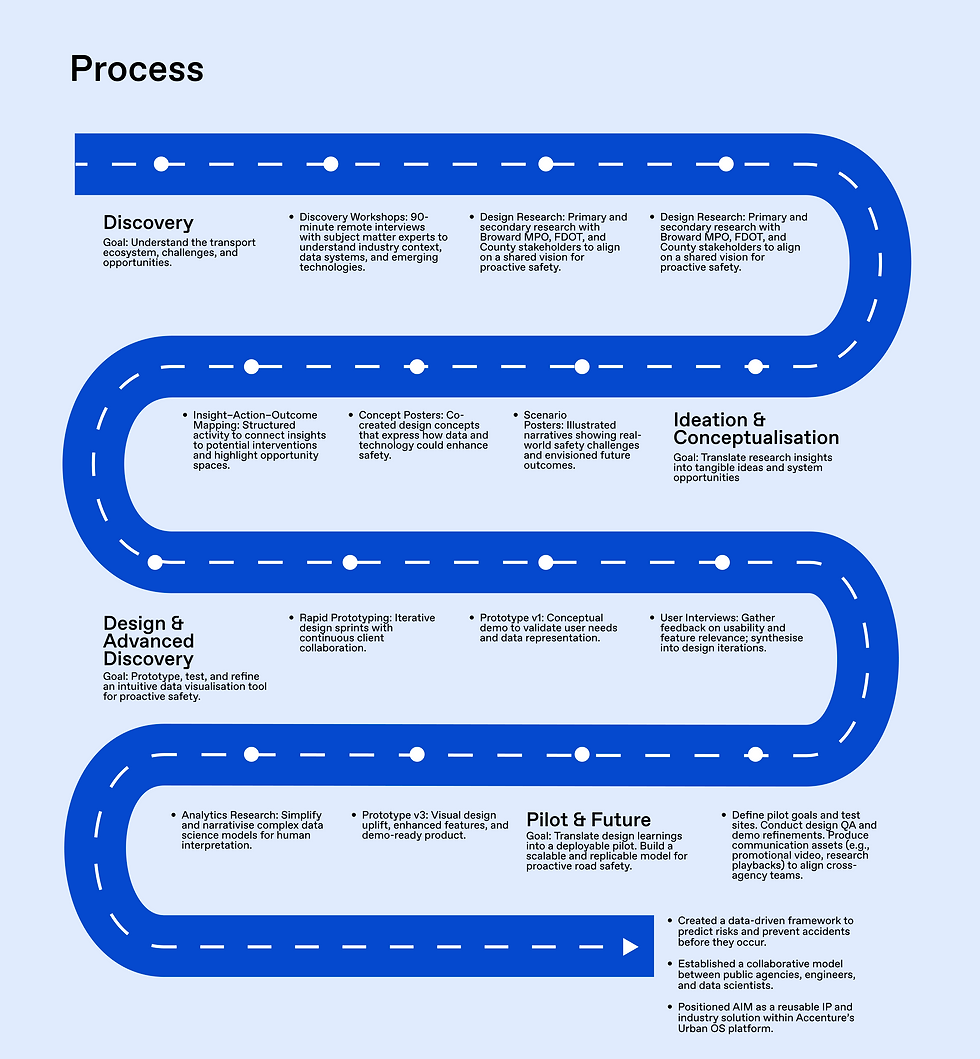
Building on insights from our discovery research, we moved into a highly collaborative phase of ideation and conceptualisation. Using co-creation workshops, scenario posters, and concept mapping, we translated real-world road safety challenges into tangible solution ideas. We illustrated how proactive safety could look in practice; through story-driven scenarios that highlighted the shift from reactive response to predictive prevention. These sessions helped bridge perspectives between data scientists, engineers, and transport planners, aligning them around shared opportunity areas. From these, we shaped three horizon concepts envisioning the future of intelligent mobility, defining key system features such as network-level risk ranking, near-miss detection, and contextualised data visualisation. This phase set the foundation for AIM’s core value proposition: a human-centred, data-powered tool that empowers authorities to act before accidents happen.


Mapping the user journey
To understand the operational complexity behind accident response workflows, we mapped the end-to-end journey across stakeholders, systems, and decision points. This helped uncover critical inefficiencies, delayed interventions, and fragmented data dependencies that directly impacted response times and roadway safety.
Designing the solution
Near misses are crashes that almost occurred.
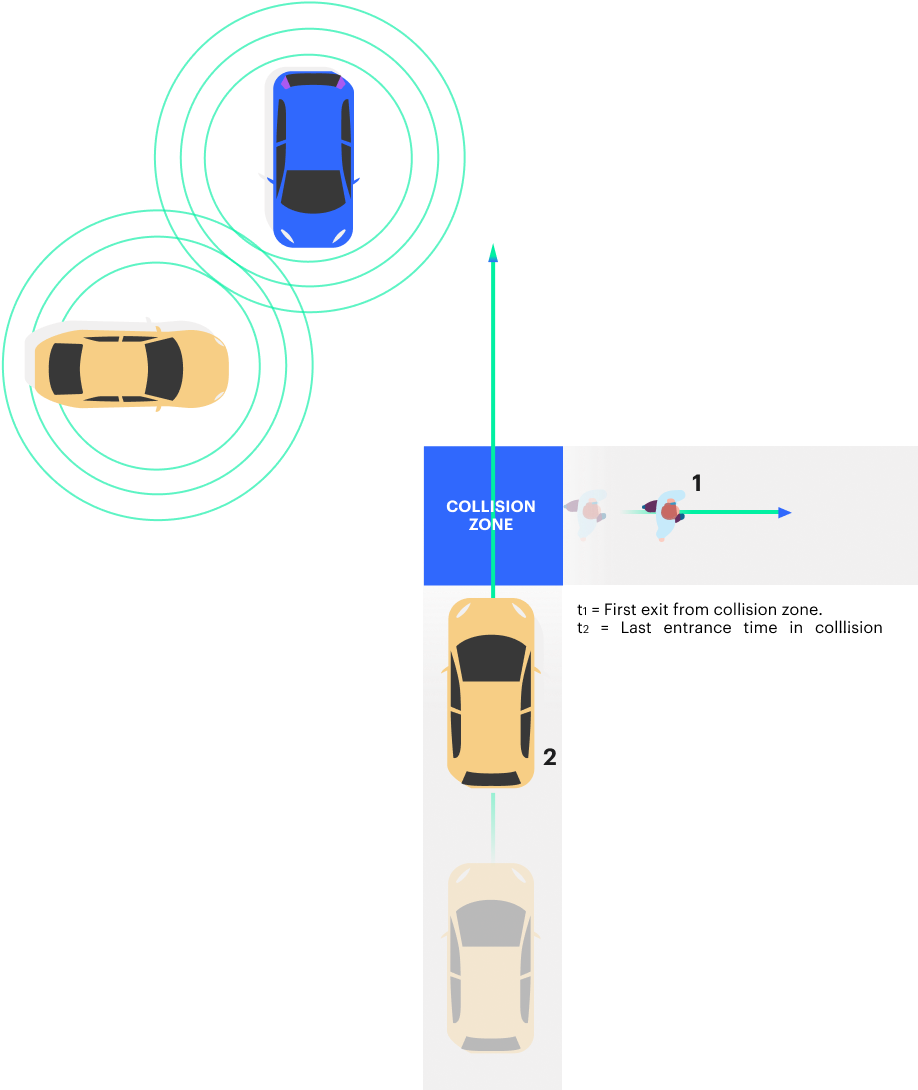
Unlike crashes, which are rare events, near-misses happen all the time. They are a strong indicator of risk but have remained invisible, up until now. Near miss events can now be detected using LiDAR, video or telematics but the sheer volumes of data they generate have brought their own challenges.
AIM helps engineers extract signal from the noise and reveal the patterns that identify the root causes of safety risk. AIM has developed a custom severity classification model that allows users to focus in on high-risk events and identify potential hotspots for serious injuries or fatalities.Once high-risk locations are identified AIM can provide users with additional contextual information like:

Our machine learning model ranks the importance of these contextual factors to predict their impact on the volume of near misses at a specific location. This functionality supports engineers in designing the right intervention for a given location as well as helping them identify similar intersections across the road network that may be subject to the same risks.


Desirability & Usability Testing
We conducted multiple rounds of desirability and usability testing with traffic safety engineers and planners to refine how data could be experienced meaningfully. Through iterative feedback cycles, we explored the most intuitive ways to visualise complex analytics—designing dashboards, spatial maps, and interaction flows that balanced depth of insight with ease of use. Each iteration brought us closer to a solution that was not only functionally robust but also desirable and trusted by the people who would rely on it daily.
Stakeholder Workshop
To prepare for the pilot, we conducted a multi-agency stakeholder workshop in Florida, bringing together representatives from the Broward Metropolitan Planning Organization, Florida Department of Transportation, and Broward County. The session focused on defining shared pilot goals, aligning on scope, and prioritizing parameters such as location, cost, ownership, and data integration. We also demoed the AIM prototype to gather collective feedback, validate usability across roles, and ensure that the pilot plan reflected the real needs and operational realities of those who would bring it to life.


Impact
81.25%
In turnaround time
32 weeks to 6 weeks
~5.3x
Faster decision making time
$5M
Pilot Deal
The AIM project not only reframed how transport authorities think about road safety but also proved the value of human-centered innovation in data-heavy domains. What began as a design-led pilot in Broward County evolved into a scalable, patent-pending safety intelligence platform with real commercial traction. AIM secured a $575,000 pre-pilot engagement and a $5 million pilot phase with Broward MPO, establishing a blueprint for proactive safety transformation across Florida. The initiative has since expanded into multiple states, with opportunities under development in California, Georgia, Ohio, and Texas, reflecting its growing market relevance. Recognized with multiple international design awards, AIM demonstrates how design can unlock commercial value while driving systemic impact - turning near-miss analytics into life-saving insights and positioning data-led safety as a new standard for public infrastructure.